Showing posts with label Lace. Show all posts

Tuesday, March 12, 2019

Three Hundred Ninety-Three Thousand Six Hundred Stitches


How do you measure,
measure half a year?

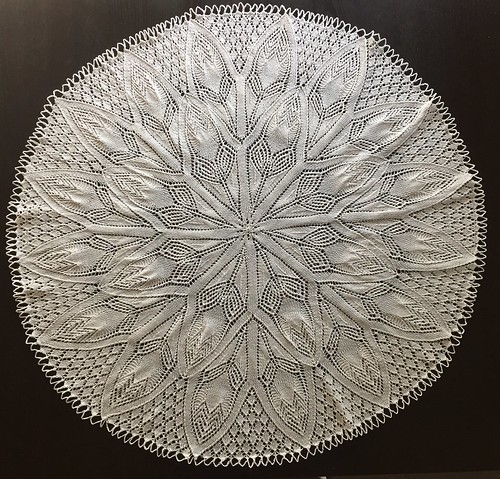
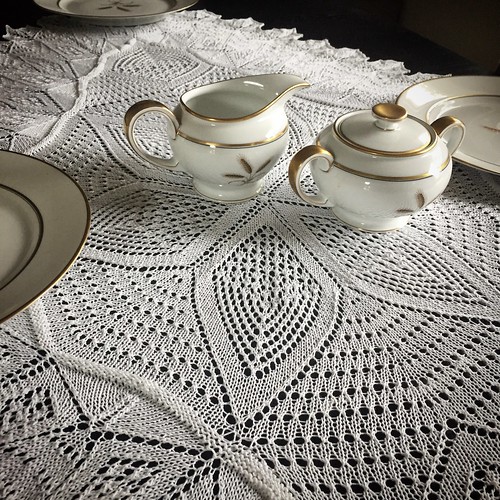
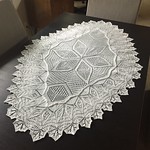
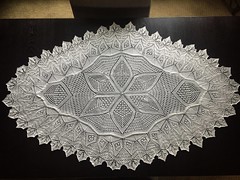
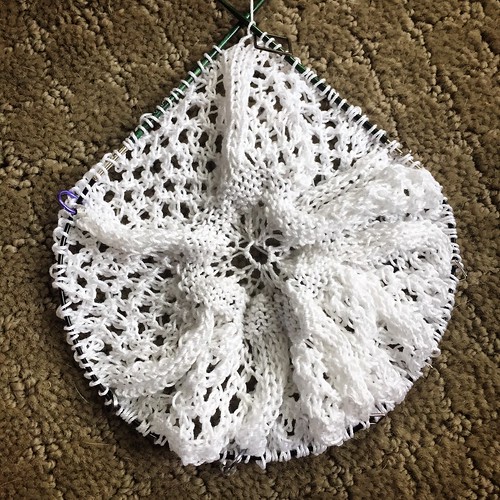
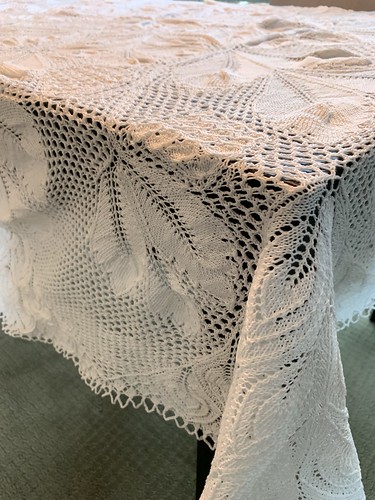
I finally finished up my Tannenzapfen tablecloth designed by Herbert Niebling this past Sunday. It was technically 393,636 stitches (not counting the crocheted bindoff edging) and took me six months and a day to complete. And there's over three miles of crochet thread in this thing.

I didn't post anything here about progress while I worked on this. When working on a stranded knitting or cables, or even plain stockinette, you can immediately see results and take joy in admiring what you've created so far. There are little milestones that allow you to take stock and reassess. But knitting lace is all about deferred dreams. After the first little bit, it's just a wad of holes sitting in your lap. It's hard to photograph, and nothing looks like it should. When it finally comes off the needles, you can see a bit of the potential, but you just don't have any sense of payoff until the blocking. And six months is a long wait for a payoff.

At first, I thought that the pine cone motifs, the tannenzapfen, would be the most interesting part. They were actually kind of a pain to knit. I ended up using thin crochet hook because I found knitting all those stitches together rather difficult. I do like how they look now, but it turns out I really like the large leaf-shaped portions best. They almost look like solid fabric next to the super-lacy double yarnovers surrounding them. They were the most boring parts to knit, but seem to me to be the most visually interesting in the end.

The instructions I used, a simplified and translated version from Doilyhead, said to simply bind off after the 405th round. But I wanted some sort of edging, so I worked out a system where by 11-stitch crocheted chains ended by gathering up 3 and 5 stitch sections along the edge. I worked a few of these into round 405, didn't like the way they worked with the previous round's yarnovers, and went ahead and added a 406th round of plain knitting. It looked much better. And after knitting 405 rounds, adding another one wasn't all that hard a decision to make.

Blocking this thing is a bit of a bear. It comes from making something knit in the round turn out as a square, which only gets one to square-ish. If you look at the whole thing in eighths, you can see that the corners are where you add some extra stitches. But it still doesn't come out right. There are lumps in the leaf motif that I'm not super happy with. I wonder if ironing the leaves flat would make the tension move out to the double yarnover sections, which, being lacier, might relax and also lie flat?
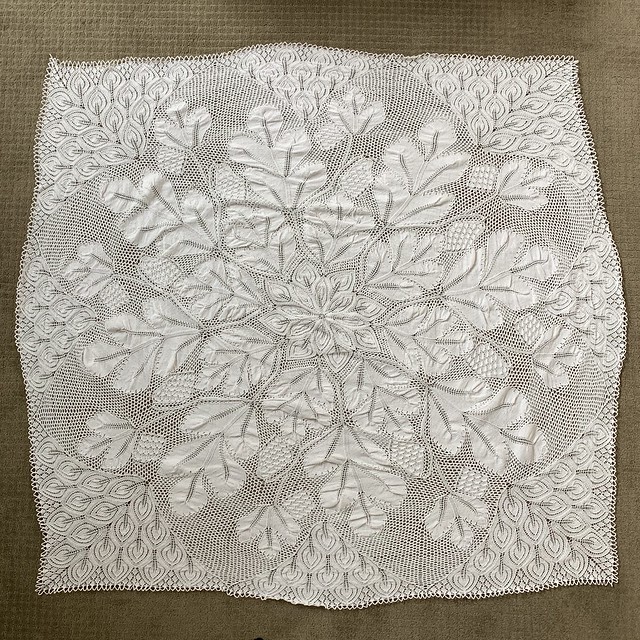

There, of course, things I wish I'd done differently. I still had some of those plastic-y ring stitch markers which worked great as visual cues for the beginning and ending of repeat sections. However, at this small gauge, the ring was thick enough to create a noticeable gutter through some parts of the fabric, even in the double yarnover sections. I'm saving those for projects on bigger needles only from now on. I also wish I'd stuck with just the jumbo put-ups of Aunt Lydia's Classic 10 crochet thread. Toward the end, I thought I'd just need a regular ball to finish, and ended up needing more. I think I made five Russian joins as I moved from one ball to another during this project. I could have gotten away with just three if I'd planned better.

Immediately after setting this out to block in the afternoon, I picked up the socks I started at Zion National Park. I'd only just gotten past the gusset decreases on the first sock when I sat down. By the time I was ready for bed, the first sock was done. It felt so good to be knitting something else!

Sunday, June 10, 2018

That's a Wrap

I finished up my Orenburg Style Wrap this weekend.

I made this out of Filatura di Crosa Superior laceweight yarn, a blend of cashmere, silk and merino that is a joy to knit with. Tinking back? Not so much. Once it's knit up, it's pretty snaggy and hard to undo. But still, well outside my usual knitting wheelhouse and fun to try. It's so soft. And so light. The finished shawl is about 44" long and 21" wide. The whole thing weighs 43g, or 1.5 oz.

The construction was new to me. It starts with a crochet chain provisional cast-on from which one of the outer edge patterns is then worked, but incorporating short rows so that it comes to a point. This forms one of the corners. I never quite got the stitch count right while doing this for the first corner, although the exact same instructions worked fine on the other three, so the problem was definitely user error. After the first corner is complete, the lower edge is knit and another series of short rows creates the opposite corner. Then stitches are picked up from the edge just created and the whole piece is worked completely side-to-side, with both the interior panel and the other edge strips being made at the same time. On the far edge, short row corners are created similar to the first edge, but instead of picking up stitches, the new edge picks up live stitches from the last row as it's knit. I wasn't really clear what was going on for a while - a diagram would have made this easier for me.

The original pattern says the finished wrap should be roughly 30" x 65". It suggests 3mm needles, but I found that my 3mm needles were too dull for all the K2togs required for this, so I borrowed some sharper needles that only came in 2.5mm. It seems that this .5mm difference translated to quite a bit of a difference in width and length. Mine just drapes over the shoulders -- it doesn't hang down into the crook of an arm. It might work well as a lightweight neck scarf if doubled up.

I'm amazed at how warm this fabric is. For not weighing much, it sure traps in the heat. I had to be careful to keep it to the side rather than in my lap or else it got quite uncomfortable. I'm also impressed with design choices that make this pattern quite accessible. Unlike the Niebling lace patterns I've made, Natalia Shepeleva's design doesn't fuss with the directions that decreases run. That is, you don't have to match a left-leaning decrease with a corresponding right-leaning one. The decreases aren't really part of the design, other than keeping the stitch count balanced with yarnover increases, so it doesn't really matter. And, it's garter stitch lace! That is, it's completely reversible with no "wrong" or "right' side. I had to really concentrate to not purl on what I thought of as the "wrong side" during the first few rows.

Although there is no right or wrong side visually, it helped to think in those terms for the purposes of tracking my way through the charts. For any given row with a side chart, a diamond chart, a center chart, diamond chart again and side chart again, one of the side charts was always one row in front of the others, meaning that the beginning of the "row" wasn't actually at the beginning of the row. Not sure is this is the way it was supposed to be, but it's the way my turned out. As long as I kept track on the charts, I was fine. And after a while I was familiar enough with them that if I got lost, I could find my place again with just a bit of counting.

Up next I'm thinking of making a cotton sweater I've had my eye on. I've got the yarn and I've been swatching. Before I got the pattern, I thought that perhaps it was a slipped-stitch pattern, but now I find it's a cable pattern. So this is going to take a bit longer than I thought. Probably won't get it done in time for an upcoming trip, but I'll try.


Sunday, April 29, 2018

Don't Dawdle, Amaryllis

Unlike Marian Paroo's piano student of the same name in The Music Man, this Herbert Niebling Amaryllis pattern seemed to fly off the needles. One month exactly from cast-on to blocking.

There's just something about the symmetry and pattern of lace knitting that I really enjoy. To start from just 8 stitches in the center, expanding outward in an expanding spiral that gets increasingly slower as you go. By the end, there were 960 stitches on the needle, with each round taking upwards of an hour to complete. And all done with one long piece of cotton thread and just a few a basic stitches. It's all so very satisfying, like putting together an intricate puzzle or constructing a complicated model. I really do like lace knitting more than I ever thought I would. And these Niebling patterns, while intricate and seemingly complicated, are really quite accessible to more knitters than you might think. They're definitely worth a try.

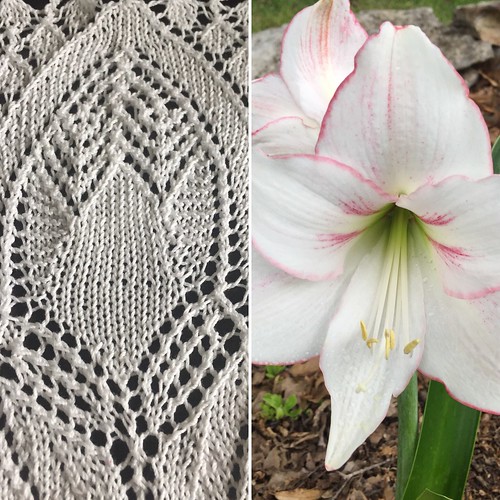
Detail of the pattern alongside my neighbor's Amaryllis
Unlike the two Herbert Neibling patterns I tackled last summer which were roughly oval-shaped (Georg and Flieder), the Amaryllis pattern is round. So there was no picking up of stitches to connect different sections -- just one giant spiral -- which was a lot easier. However, putting in life lines across so many stitches was a bit problematic - but necessary. A few times I found mistakes -- usually right after putting in a lifeline, but in each case I was able to figure out what I'd done wrong, ladder down the stitches, and re-create the pattern correctly. This is so much harder to do in lace than in more traditional stockinette knitting, but do-able if you pay attention to which row you are on. And if you're patient. And if the problems are fairly simple. I found that the surest way to avoid problems was to do a lot of counting as I went -- this left leaning section has 13 stitches on this row, the yarnovers in this direction always take place after 4 plain stitches -- that sort of thing. I have a tendency to do that in my head about all sorts of things anyway, so I kind of find it soothing.

Sample from Amaryllis pattern
This pattern can pretty much be done from the charts -- I didn't have to rely too much on the brief instructions in German that I'd run through Google Translate. There was one section I couldn't quite figure out, which features a small box near a place where the chart seemed to shift over. It looked like it read 5 M. z. , although it was a bit fuzzy. The key in the original pattern reads Maschen zurück d. h. so viel Maschen der folgenden Runde, wie die Ziffer im Zeichen angibt, auf die letzte Nadel der vorigen Runde rechts stricken. Google Translate kicked this back as Mesh back d. H. knit as much stitch as you want on the next round as indicated by the number in the symbol on the last pin of the previous round on the right. Even this didn't quite make sense to me (wish I could figure out what that d. h. abbreviation means - maybe something about the round marker?). I ended up removing the beginning-of-round stitch marker, knitting 5 stitches, replacing the marker and continuing. Seeing that visual 5 stitch difference between rounds 107 and 109 made me think this was the way to go. For the rest of that round, each of the 16 markers (one for each Amaryllis blossom) had to be slid over 5 stitches. It seemed to work. And that strange little 5-stitch section of stockinette has no effect on the entire piece, or course. Not sure if this is what Herbert intended, but it's what happened.


Blocking this thing was a bit of a bear. I used my thinnest blocking wires and ran them around the outside through every other gathering of stitches at the base of each of the 224 edge points. Then I bent them gently into arcs and tried to get a uniform diameter. It ended up varying between 32" and 33" inches across. Sadly, one of the blocking wires bent permanently. But I was able to get it more or less round. Then I needed to pin out the points. I used all of my T-pins and a bunch of yellow-headed pins that I'd gotten at some point. I still had about 50 points to pin. I found a package of safety pins and opened up each of those. Then I grabbed 8 pins from a shirt I'd just bought and unwrapped. Still two short, so I grabbed some cork board push-pins. Whew. It was close. Janelle told me that T-pins make great stocking -stuffers. Just sayin'. While it was damp, I sprayed the whole thing with spray starch (need some more of that, too) and by the next morning it was dry. I love that swishy sound it made when pealing the stiff cloth off the blocking board. Since removing it from the pins and wires, it has tended to gather in a bit and won't lie quite flat. I think it would work better if it were draped over a small table. Still not entirely sure what this tablecloths ultimate fate will be. But so glad I made it.

What's next? More lace, I think. But brightly colored. And much softer... Thanks for stopping by!

Sunday, August 06, 2017

Lilac

As it gets hotter and  hotter and the world gets crazier, all I want to do is stay indoors and make pretty lacy things.

This one is Flieder, another Herbert Neibling design, but about three times larger than the Georg doily I made last month. Flieder is German for lilac. Neibling produced more than one pattern with this name, but I'm not sure how he saw anything bout lilacs in this particular pattern. The central flower has six petals, and little lilac blossoms have four. Still, it's Neibling's world and we're just living in it. Flieder it is

While shopping for thread -- and I got each of the three balls from three different craft stores in Austin --  I saw that Aunt Lydia's Classic Crochet 10 comes in a light purple, dare I say, lilac color. But that would have been a bit too literal and I would never have used it. White is the way to go with this, I think.

For those interested in such things, here's a little schematic of how this particular sausage was made.The central portion, marked in green, starts with 6 stitches in the middle, one for each petal that grows outward, knit in the round. After completing that, the two sections marked in, let's say, lilac, are knit flat (back and forth). After this, stitches are picked up around the purple sections along with the held live stitches from the remainder of the green so that the work is again done in the round. Four rounds of dense purling with the thread held doubled follow, and then 20 repeats of the pattern are knit up to the orange line. After that, the pattern shifts to 40 repeats. That's a lot of stitch markers. And a lot of stitches on the needle. By the end, there were 1,440 stitches on a 32" needle. I don't have a US0 (2mm) 47" circular needle. I wish I did. Things got quite crowded. I also experienced that weird thing with center-out projects -- the closer you get to the end, the slower your progress. It can be a bit maddening. Everything up to the orange line took 5 or 6 days to knit. Everything outside of that took an additional two weeks.

Please don't think that all this explanation is meant to impress, or to warn you off lace knitting. My point is that it's not nearly as hard you might think. I've made two oval examples, which are probably more fiddly than most. I would think that a square table cloth or round doily would be a bit easier, but just having a basic idea of the construction, using Google Translate, and finding some online German/English knitting glossaries is all you really need to get started. Then it's just a matter of not dropping stitches and not loosing one's place in the pattern. And time.

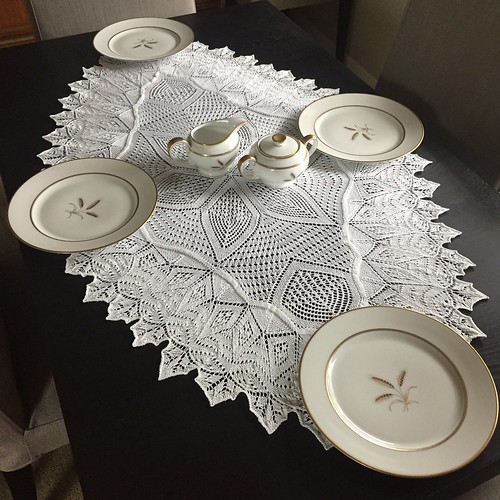
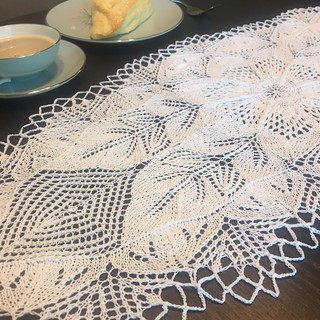
This fits our dining table perfectly, which was a fluke, really. I just lucked out on that one. I'll likely just use it for special occasions. This morning, I set out some of my Grandma Self's china on it to see what it looks like. The story in the family is that my grandmother didn't really even want fancy china, but my grandfather insisted that they get some while they were living Germany after WWII and had the means -- they'd been so poor when they got married during the Great Depression. It came down to me eventually. A scent I noticed as a I was pulling it out of the cabinet triggered a sense memory of my grandparents house and Thanksgiving dinners in San Antonio. And they look great together, I think, German dishes on a German-designed doily. My family has had so many connections to Germany -- my Kohrs and Weber ancestors immigrating from there to Texas in the 1850s, my grandparents and father living there 100 years later, and my brother's family making their lives there now.

Only 109 days until Thanksgiving!


Saturday, July 08, 2017

The Doily Chronicle

When I started knitting twelve years ago, I would have scoffed at the idea of spending time and effort making a lace doily. But today, I finished my first one -- the Georg doily designed by Herbert Niebling.

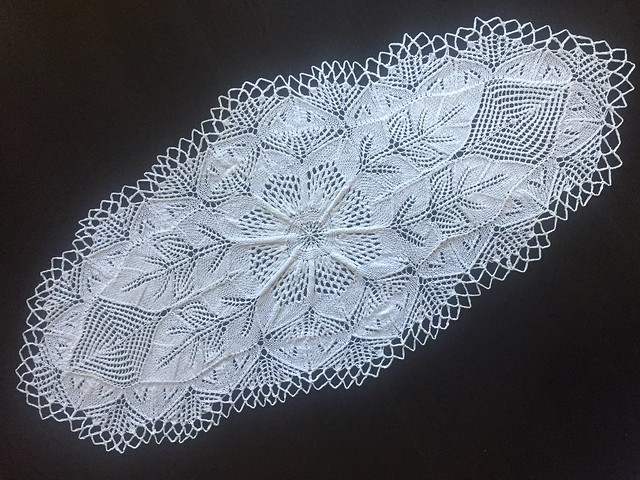
And I say first one, because I'm going to likely make more. Yes, they're challenging and fiddly, but as a process knitter, theses are the things I kind of like about knitting. Seeing the symmetry inherent in the pattern gives a certain satisfaction. And observing how the squares and symbols on a lace chart translate into leaves and petals makes me want to keep going to see what happens next. Then, of course, there's the challenge of keeping all the balls in the air as it grows and grows. The first round of this project, started in the middle, had 8 live stitches. By the time I got to the cast off, there were nearly 500.

Here's a walk through how this thing is constructed. Starting at the pinhole cast on in the center, the central flower is eight repeats of the same motif knit in the round, creating the petals, with slight variations on opposite sides to set up the oval extensions. Those sections are knit flat (purling on the back side) out to the ends. Then, stitches are picked up around the oval extensions along with the remaining live stitches from the sides of the central flower.  A 20-round pattern repeated 16 times around the whole doily created the leaf points and lace edging.

Then, all that's left is the crocheted points around the outside. The first round serves to bind off the edges of the knitting and create little loops. The second round builds on those, plus pulls the ones opposite the leaf points together. I was intimidated by this part because my crochet fu is not strong, but I think I managed. It was a little tricky to figure out how do the attaching, but I just picked a method and stuck with it. I found myself really wishing my crochet skills were stronger as I finished this up.

I completed the crochet edging yesterday afternoon and went online to find out some blocking options. One was to mix some liquid starch and soak the whole thing, but the video examples I saw led me to believe that it would end up too stiff. I wanted it to have some structure, but I didn't want it stiff as a board, either. I decided to go a bit simpler. I soaked it in warm water (which left the water strangely murky -- this is just cotton, what was up with that?) then placed it flat on a towel draped over my blocking board. Then I got out the regular can of spray starch that I use when I iron shirts (ahem, which isn't often) and went to town. I pinned out all the outer loops to make points. This part was fairly tedious. Not sure I did the tidiest job, but it looks pretty good overall.

In the original design, the central flower, a few rows in the middle and the crochet loop points were all done in a black yarn (see below). Couldn't quite see the point in that -- I thought it looked a bit odd. But tastes change. Consider that one of the staging shots for one of the patterns in the book features an ashtray with a lit cigarette resting on a doily. Not something you'd likely see in a pattern book today!


I enjoyed this project way more than I had anticipated. I was surprised by the sense of dimension in the finished object. The way that the fields of stitches and lacy holes ran in different directions created textures and shading that I hadn't imagined. I'd always though of lace as being very two dimensional, but it doesn't have to be. I was so impressed at the thought and care that Niebling put into this design so that everything lined up and worked together just so. I want to knit more!

Tuesday, June 20, 2017

Doppelumschlägen


My latest knitting adventure involves intricate lace patterns. Written in German. Help.

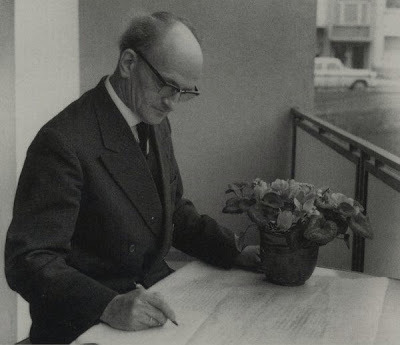
For a while I've wanted to knit a fancy lace design by the German lace designer Herbert Niebling (1905-1966), a man who needs a Wikipedia page if anyone does. He churned out hundreds of intricate knitting patterns for tablecloths and doilies in the mid-20th century. Many of the designs feature stylized flowers and plants. Reading through their names is like reading a German botany book -- Eiche (Oak), Ahornblatt (Maple Leaf), Hängeblume (Hanging Flower), Löwenzahn (Dandelion), Erdbeere (Strawberry), Tannenzapfen (Pine Cone) -- the list goes on and on. Then, randomly, there are patterns with people's names attached to them. Some of these patterns are enormous and would take months of painstaking work. Some are just tiny little coaster-sized things. I kind of want to knit them all, but can't figure out how any human being could ever knit all these in a lifetime, much less design them, too.

I decided that for my first foray, I'd settle on something smaller than a tablecloth, but which I could still trot out as a centerpiece for nice dinners. Having something like this, I assume, will make me want to host nice dinners. I decided on a pattern called "Georg," which is oval-shaped and doesn't really have to fit over a piece of furniture -- it just just has to lie flat on top of it. Plus, a knitter in Ravelry had already made a beautiful example and had basically translated parts of the pattern for English knitters. Decision made!

I got some crochet thread and some size US0 (2mm) needles and got to work. And then started over. And then started over again. I was having trouble with the double yarnovers in the pattern and dropping stitches left and right. I finally managed to fall into a rhythm, but it was a bit of a struggle.

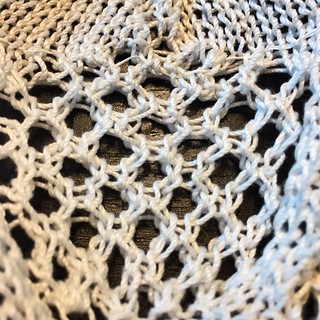
After finishing the 40th round, I finally dug around on some online forums to find out more about double yarn overs -- for non-knitters, this is wrapping the yarn around the right needle twice. Very simple. The effect is to create a hole in the fabric, which is kind of lace's thing. But working these loops on the next row is another matter. I just knit into them again, which created a strange string that draped across. Since the row after that involved decreases that pulled the previously-created holes to one side or another, I didn't really think anything about it. It looked okay to me. But reading today, I found that everyone one in the lace-knitting universe knows that you don't just knit into those two loops. You either knit then purl, or purl then knit, or knit then knit into the back of the next loop. But one thing they all agreed on: one simply does not knit into a double yarnover twice on the next row. See the triple-strand ladders running between the honeycomb-like holes in this detail? That's what happens when you do what I did. Why didn't anyone tell me this?

Well, apparently, Herbert Niebling did. Right there in his instructions, he says Auf jede Musterrd. folgt 1 rd. rechts, in der man nur aus den Doppelumschlägen 1 M. link 1 M. rechts strickt, which Google Translate kicks out as "On every pattern follows 1 approx.(?) on the right, in which one knit 1 st on each side from the double turn." I've learned that the German words for knit and purl translate as "right" and "left," so "knit one stitch on each side from the double turn" is basically knit and purl into the double yarnover.

So now my favorite new German knitting vocabulary word is Doppelumschlägen (double yarnover). And now I know what to do with these. So it looks like I'll ripping back to row 11 again. In the meantime, I need to get back to lurking on the forums to see what other tidbits about lace knitting I don't know. Nothing like learning a whole new language in a whole new language.


Sunday, June 11, 2017

Taking the Wraps


After the challenges of the Marius pullover, I was ready to work on something a bit more calming and mindless. Nothing for that like knitting quadrilaterals.

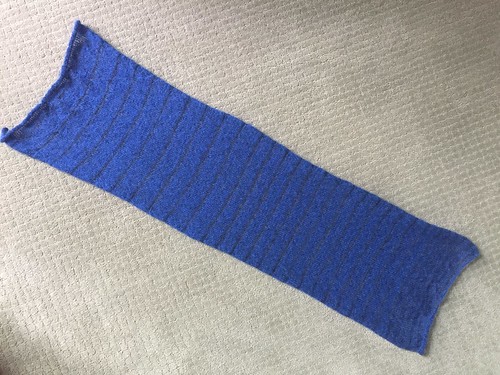
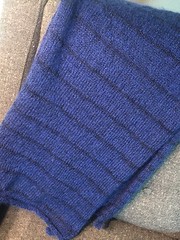
First up was the Sommerbrise Schal, the yarn and pattern for which I got from Heidi, the proprietor of Maschenwerke in Frankfurt last summer. Andrea from The Fruit Knitting Podcast had graciously taken us there to see her beautiful shop, and while there I saw a beautiful scarf that Heidi had knit using two kinds of Ito yarn, Gima 8.5 which is a sort of cotton ribbon, and Sensai, a mohair/silk blend. So out of my wheelhouse, yet so light and airy that I thought I'd give it a try. Of course, I went for some darker colors than Heidi, but she helped me select a dark navy Gima and an electric blue Sensai that worked well together.

I cast on for this in November, but I didn't really get started until a month or so ago. It's a relatively easy pattern, with the two different yarns held together for much of the project, but then using only the dark color for stripes that gain in frequency toward one end. It was beautiful to knit with, and a real lesson in working with fibers and yarns outside one's comfort zone. It was a fantastic exercise. It's only 50 inches long, but can be bunched up around the neck nicely. Not exactly my cup of tea fashionwise, but I'm thinking of taking it to a silent auction that a professional group I work with runs in the fall. I'm hoping it will raise some money for student scholarships.

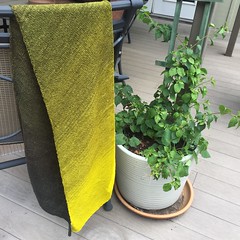
Then, after knitting with friends on Saturday a few weeks ago, my friend Jene and I headed over to Hill Country Weavers' new location and talked each other into knitting their free A Biased Scarf pattern with some Freia Handpaints Ombre lace yarn. I choose a dark gray that slowly morphs into a bright acid yelllow/green. It's a pretty easy pattern - cast on 80 stitches, increase and decrease one at the ends of each right side row, and purl the wrong side rows until you run out of yarn. I started with the dark end. Although the pattern was simple, I enjoyed the slow gradient shift toward the brighter end. Since it's knit on rather large needles for a laceweight yarn (US 6, 4mm), it has almost no curl after blocking. It really is quite beautiful and drapey. Again, though, not really my style.

That's why I'm giving it to our friend Rhonda. She and her husband David have become such good friends in the last few years and I wanted to do something to show my appreciation for all they've done for me and Jeff. I think she likes it and it looks great on her.

Up next in the world of things you wouldn't imagine I'd want to make -- a lace table runner. Weird, huh? I've always thought they were beautiful, and I've lately become obsessed with the intricate designs of Herbert Niebling, many of which are named after plants and flowers. I'm particularly enamored of one called "Georg" which is oval shaped. I think an oval-shape would require less "fitting" around a table. Also, it wouldn't cover the whole piece of furniture. I've never done anything quite this intricate before, and I have the feeling I'm not fully aware of what I'm getting into. First of all, there's tracking this pattern down. It's been reprinted in at least one book since it was produced in various pamphlets in the mid 1900s, but that book is hard to come by. I'm trying to get it through interlibrary loan at the moment. If that fails, I may have to bite the bullet and see if I can get a copy from an online auction, although they are rather expensive.

On top of that, there is the fact that this requires very thin cotton crochet thread, and very tiny needles. I'm not really scared of either of these things, but I'm aware the potential for frustration is quite high. Then there is the issue of translation, although other people who have knit this say the German isn't too difficult and the charts are pretty easy to figure out. Here's hoping.

So that's on the back burner for now. In the meantime, I've ditched the socks I'd had on the needles forever. I'd gotten started on them, got uncharacteristically distracted by something else, and then set them aside and the mojo was lost. So instead, inspired by Janelle, I'm using the sock yarn to make a Sockhead Slouch Hat. I've wanted to do one of these for years and it's the perfect placeholder to keep me busy until I can track down Georg. I know he's out there somewhere...

Sunday, February 02, 2014

A Drop of Golden Sun

I'm coming up for air after a flurry of knitting with no accompanying blogging. Not much to report with lace knitting in-the-round. Yarnover this, decrease that, join another skein, blah-blah-blah. I had a little excitement when I realized I needed a seventh skein to complete the project, coupled with joy that the yarn shop still had another one in the same dye lot. So I decided to wait to bore readers with the details until it was finished. And as of today, it is. I finished knitting it with my knitting group yesterday morning, wove in the ends when I got home, and washed and blocked it in the afternoon.

Since it's cotton, I washed it in the machine. I wanted to make sure it didn't fall apart. It didn't. But it was so heavy when wet that the washer wouldn't spin fast enough to get it past soaking and merely to damp -- it caused the whole thing to go way off balance. So I tossed it in the drier on low for 20 minutes to get it to the right dampness. All pointers I can pass on to those who will be caring for it.

The picot edging has 240 points on it. Ideally, I would have pinned out each one, but I don't have that many pins -- or that much patience. I made do, trying to make sure that each point was 30" from the center, making for a 60" diameter -- which just about fits on this old beach towel that I use for blocking big projects. The only place with floorspace big enough was in the living room, so I had Jeff help me move furniture around to create a Fortress of Blockitude, impervious to curious dogs. Frankly, I was a little disappointed that Pona and Kate didn't show much interest in my efforts. But if I hadn't done it...

I'm always fascinated by how magical lace is, being based on nothing but making holes and gathering them back together. And how it never reaches its full potential until blocked. Even in cotton, it smoothed out and shaped up noticeably after a good blocking. The sun pattern in the center spreading out from the clever cast-on is my favorite bit. But I also like the diagonal lace bars that shift directions as they move outward. I thought the knitted-on picot edging would drive me crazy with the amount of time I anticipated it would take. But it wasn't too bad. The six row repeat was quickly memorized and was easy to read as I went along. I can highly recommend this pattern. It's not particularly difficult. And, as with most Jared Flood patterns, it's very well written. I can't wait to see how this is received!

Sunday, January 12, 2014

Girasole Start

I've had Jared Flood's Girasole pattern in my Ravelry queue for years, and Friday, I got some yarn to make it. It can be knit in any size, really, since it's circular. The pattern suggests a sock weight yarn for a shawl, or worsted for a blanket. I'm using more of a sport weight, so let's say this will be a throw.

It's going to be a gift, so I'll be a little cagey about my planning but I will say I did have a bit of trouble with the color. I wanted to make something bright, but the color options at hand were either neon or pastel -- not quite right for this project. Then I saw this Cascade Ultra Pima cotton yarn in a shiny antique gold color -- washed out to a camely-beige here by my color-distorting phone camera. But the actual color is vert fitting to me, as the center of the pattern looks like the sun. The label, however, says Mushroom. Hmm. No wonder it spoke to me.

I cast on right away Friday, and immediately it started with a bit of a challenge - a new (to me) cast-on technique: the circular cast-on. Two sites are suggested in the pattern to get details. I found that the option using a crochet hook worked best for me. It's pretty cool, and not that complicated.

In true lace-from-the-center-out fashion, I've made great progress this weekend, having worked my way through the first three charts and one of the six balls of yarn I estimate I'll need. But now things will slow down as the circumference increases. No worries yet. I still have time. In the meantime, I'm enjoying the novelty and at the same time marveling at the number of projects I have going at once. For me, this borders on spinning out of control.

Sunday, March 24, 2013

Stint O' The Wave

It's over! I finished the Print O' The Wave Stole yesterday. I soaked it and put it on the blocking wires yesterday afternoon, and went in to take a look this morning, after leaving it under the ceiling fan all night. There it was, in all its lovely laciness. I'm so happy!

Despite the mid-project disaster, this was a really fun pattern. In fact, it only has two charts to follow and neither of them is overly complicated as long as your are willing to embrace the K3tog. Mostly, it's a marathon. And like, most garments with a knitted on border, when you have the main part finished you're really only half way there.

For me, once the external instructions get incorporated into internal rules of knitting grammar (the K3tog stitches always look like this, every other odd-numbered row has a yarnover 3 stitches from the beginning of the row, etc.) the whole process seems to flow. As I described to a friend yesterday, it's like anything you learn by rote; what seemed so foreign at first almost becomes second nature. Although I kept the sheet with the edging pattern on it handy for the past few weeks, I rarely consulted it. However, it can be hard to get back into the flow state when you get interrrupted. For instance, I don't recommend watching intense TV shows while knitting this pattern. I'm talking to you, Breaking Bad. I'm convinced watching this show dragged out the timeline on this stole significantly.

As I've mentioned before, the hard thing for me about knitting lace is waiting for the payoff, which doesn't happen until the blocking. Until then, it all looks like a wrinkly mess. And I had trouble with the blocking. I really wanted to make it fit the dimensions in the pattern -- 80" x 25". But when I tried to stretch it to these dimensions, my blocking wires started bending and pins started popping out of place. I'm lucky I didn't break any of the stitches. The pattern calls for blocking it "aggressively," but I think I was bordering on abusive. I backed down to 72" x 22", which, considering I had knit on size 3 needles instead of the recommended size 4, seems about right.

I didn't make this with anyone in mind, so I'm unsure of its fate. I mostly just wanted to get some more practice with lace and to burn through some lace yarn that I'd gotten at a swap. So, mission accomplished. I can recommend this to anyone wanting to attempt a lace project involving grafting and knitted-on edging.

My next project will not be aqua, blue-green or turquoise, will not take two months to knit, and will be done on gigantic needles.

Friday, March 15, 2013

Murder, She Knit

I’ve been watching a lot of streaming stuff this week while trying to plow through the knitted-on edging of the lace stole. Some of it good, some of it not so much. But I did run across a neat little documentary that I found fascinating, and which included a bit of knitting.

photo (2)Of Dolls & Murder covers the contributions of Frances Glessner Lee to the field of forensic medicine and the development of crime investigation. Lee, who was from a wealthy family connected to International Harvester, was not allowed to seek higher education. However, through her brother and and one of his college classmates, she became interested in the science of crime investigation and endowed the department of legal medicine at Harvard. But her unique contribution to the field was her creation of 18 incredibly detailed miniature dioramas of crime scenes that are known as the Nutshell Studies of Unexplained Death.

They’re amazing. At first glance, they look like regular little dollhouses. But then you see the bodies, and the blood splatters, and the signs of a struggle, and the open windows. Supposedly, only a select few know the “answers” to the mysteries outlined. And though they were created in the middle of last century, they’re still used to train forensic investigators today. Lee created these herself, by hand, even knitting the victims’ stockings on what must have been very fine-gauge pins. Despite their grim nature, they are quite beautiful.

On the personal knitting front, I continue to plug away at the Print O’ The Wave Stole. I’ve completed three sides of the knitted-on edging, and “only” have one more long one to go. I really want to be able to stretch this thing out so I can see the pattern better. For right now, it just looks lumpy. One of the nerve-wracking things about lace knitting is having to wait so long for the payoff. But the end is in sight. I suppose it’s time to put some serious thought into what I might tackle next.

Sunday, March 10, 2013

The Needles on the Edge of Forever

I've literally turned the corner on this stole. The hole is fixed, the pieces re-grafted, the yarnover setup edge finished, and I've completed one short edge, plus a corner of the knitted-on edging.

I love how knitted-on edging works. But I couldn't figure out how to start. I'd forgotten that one has to work clockwise around the work, in the opposite direction of usual in-the-round knitting, in order for the edging and the body to be joined on the backside of the work. When I got started with the edging, I just stared and stared, wondering why everything seemed backwards. Then it just came to me in a flash. Thank goodness. I've completed 11 of the 73 repeats of the 16-row edging. Although that sounds daunting, I'm actually quite pleased that I've gotten as far as I have. But still a long, long way to go.

The college is on spring break this week, so I'm hoping I'll have lots of time to make more progress. But I'm also playing bachelor for a few days while Jeff is out of town, so I have a few more responsibilities around the house than I normally do. I've managed to maintain a certain level of civility and haven't devolved into a caveman yet. Smooth sailing, so far. Just ask Pona.

Sunday, March 03, 2013

Wave Function

Just a quick post to show that I've been able to get my problems with the Print O' The Wave Stole fixed. Jeff and I stretched it out for a thorough inspection. No holes this time!

Yesterday, I finished knitting the two sides and this morning I completed the grafting. I hit a snag where I came up with an uneven number of stitches during the grafting process, but ungrafted about a dozen or so stitches and found the problem. I purposely grafted very loosely, and then snugged up the grafting across the piece stitch by stitch to match the tension of the two sides. You can still tell where the grafting is since it's the only 3 rows of stockinette in a field of lace, but it's as smooth a transition as I can manage.

First I need to weave in some ends, and then pick up stitches around the edge. I did some math, and I'll have to pick up 7 stitches in every 12-row pattern repeat, plus two more somewhere along each edge. And I can look forward to unzipping those pink crochet chains soon.

Wednesday, February 27, 2013

Stole Survivor

All is not lost, and the Print O' the Wave Stole is back on track. I've fixed the hole of yarn barf -- the knitting version of norovirus.

After calming down, and after listening to everyone's sage advice, I realized this was a pretty straightforward, if nerve-wracking fix. I un-grafted the two pieces carefully. My original plan was to put one side directly back on a needle -- until I realized I was saving the side with the hole. So I just picked out the grafting yarn.

Once I had the pieces separated again, I set about identifying a good fallback position. The 11th row of the pattern has a distinctive 3-stitch decrease bordered by several groups of 5-stitch stockinette sections. For each side, I marked one of those 3-stitch decreases, frogged back to the row before, and then slowly removed Row 12 as I carefully put Row 11 back on the needles. I had a few minor mishaps, but was able to fix them.

So now, I have two pieces, one with 16 of the 17 pattern repeats intact, and one with 13 -- the side with the hole. Turns out it must have been a slipped stitch since the yarn wasn't broken. The dogs are no longer canines of interest in this case.

Shouldn't take too long to catch back up. Thanks, everyone, for the advice, encouragement, and sympathy. Onward.


Monday, February 25, 2013

Crashing Waves

I'm done with this stole earlier than I thought I would be.

I grafted yesterday and this evening without any incidents. Everything looked great. You can kind of see the grafting line on the left in the photo. But as I stretched the stole out to admire my handiwork, I saw a hole that looked bigger than this pattern's typical yarnovers. And, as I looked closer and did a little feeling around, it grew.

At some point, I must have dropped a stitch, and for some reason, I didn't catch it as i was working. At this point, I've already grafted the two halves and pulled out all my lifelines. I think the Print o' The Wave Stole has officially sunk. A whole month's worth of knitting, gone.

I feel numb.

Sunday, February 24, 2013

Tension

A brief update on the stole. I spent too much of this gorgeous weekend working on it so I could say I made some progress this week. I don't seem to be able to squeeze in as much weeknight knitting as I used to.

The two sides are done! Now, I get to embark on the longest grafting sequence I've ever attempted. Just doing up a toe across 10 or 15 stitches can be pretty unnerving, so who knows what 80 will be like? Just longer, I keep telling myself. That's the only difference. Same thing, just more of it.

I'm a little concerned about maintaining the tension in lace. That's the thing with lace -- it has the opposite of tension. I'll have to remind myself to stay loose in more way than one. In re-reading the pattern, I was pleased to realize that the grafting is done with the live stitches, not using the provisionally cast-on stitches as I'd been assuming. So I get to put off unzipping those crochet stitches for a while, and all the tension that will likely create.

Deep breaths.

Saturday, February 16, 2013

Second Wave

Just plugging away on the stole. I thought I'd check in, even though there's not much to report.

I have recently allayed a few fears I had about this project. One was that I would run out of yarn, but I got the 17 repeats of the main pattern on the first side, plus 2 repeats of the pattern on the second side completed with only 29g of yarn. I've still got 36g of a wound ball, plus 50g more unwound. I think I'm good there.

My other fear was that I'd made my first provisional cast on crochet chain too tight, and that it would make the stole gather in toward the middle. You can see what I mean with the pink on the leftmost section in the photo. But a few experts have assured me that if I can get those stitches back on the needle, I should be fine. In the meantime, I need to get back to knitting, and try not to think about the hundreds of stitches that will need to be picked up in the near future.

Yarn over and out.

Sunday, February 03, 2013

Lace Stole

While digging around through my purposely scanty yarn stash, I found some blue-green alpaca lace-weight yarn that I got in a yarn swap a few years ago. It’s just been sitting around, waiting for inspiration. I didn’t have anything else immediately lined up, and since I’ve got a few lace projects under my belt now I thought I might be ready to tackle this. My previous projects have not been in lace-weight yarn, however, and this is turning out to be a whole new ball of wax.

First of all, those stitches with the big open holes are really slippery! I tried to do this on a pair of regular Addi Turbo circulars I already had, but had to go get a pair of pointier, less slippery lace needles. Things are better now, but I still feel like I’m on shaky ground. Yarnovers keep jumping the markers, and I have to carefully count between each one as I go. And I’m not getting a rhythm to the pattern. I’m still tied to staring at it, which is a bit tiring. Still, when I spread it out it looks about right.

I’ve done 3 of the 17 repeats for just one side. This is going take a bit longer than I originally thought.